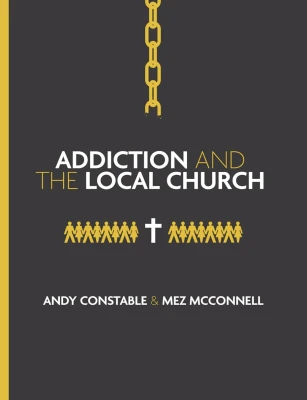
Addiction & the Local Church - Book Review
Posted 12 Dec 2025
If you are looking for a book that approaches addiction with biblical clarity, genuine compassion and the vital role of the local church, this is a very helpful resource. It gathers much of the best thinking already available but presents it clearly and accessibly with each chapter inviting reflection and discussion. The authors draw from extensive first-hand ministry experience and include testimonies that give the book a genuine sense of authenticity that many will find both relatable and encouraging.
Given the breadth of experience that Andy Constable and Mez McConnell bring from their work with addicts in Scotland’s schemes (and beyond) through 20Schemes, we have come to expect a high standard from them. We have personally benefitted from the wider 20Schemes ministry through those who have engaged with our own recovery meetings and participated in our Day Programme. For that reason, much of what they share in this book resonated deeply with us.
What Encouraged Us
A clear and biblical understanding of addiction.
The book helpfully pushes against assumptions and demonstrates clearly that Scripture speaks meaningfully and convincingly to the issue of addiction. Many people—inside and outside the church—are surprised to discover this, and the authors handle this with care and clarity, showing how the Bible meets people in real places of pain and provides hope that is both realistic and profound.A strong gospel emphasis.
The authors rightly highlight that although addiction is a serious issue, it is not the ultimate one. Rather, our deepest need is forgiveness of sin and reconciliation with God in Christ. We often say that addiction is a symptom of a far greater spiritual issue. Like the paralytic in the Gospels, we often seek a particular kind of help while the Lord Jesus opens our eyes to a greater need.A strong link to the ministry of the local church.
The authors affirm what we too believe: that the local church is central in caring for and discipling addicts. Their cautions (and some encouragements) of recovery groups are offered with a desire to help churches think more carefully about how to engage with wisdom. That is our strong conviction as an organisation that seeks to resource, train and equip the local church for reaching addicts.A call for ordinary believers to move toward the addict.
One of the pastoral strengths of this books is that it encourages every believer to step toward those struggling with addiction, rather than step back with fear and uncertainty. If sin is truly universal, every Christian can find common ground with the addict rather than distance. We wish more believers would take this seriously.A recognition of complexity.
The book avoids simplistic explanations, acknowledging that while addiction begins with choices, the effects of sin reach deep into the human heart. People are both sinners and sinned against, and ministry requires avoiding both a moralistic and defeatist attitude as well as a simplistic approach that lacks compassion.An emphasis on thoughtful care and long-term discipleship.
The authors warn against simplistic “one size fits all” approaches and against making “trophies of grace” out of the addict. Ministry with addicts is rarely quick or easy, and as we walk the “hard yards” with people, we must remember that every Christian is a testimony of God’s grace, but not every story is ready for the spotlight.
Areas We Would Have Welcomed More Reflection
While we resonated deeply with the core arguments, we would have appreciated a few additional caveats—particularly regarding recovery groups, which are commented on at various points. Having walked with many who have gone through these programmes, and having come from within them ourselves, several observations come to mind.
The varied ways God works through recovery groups as an expression of His common grace.
While some come to Christ first and see addiction lose its grip afterwards, many experience a more gradual awakening—a sense of God at work, a change of direction, a hunger for meaning—long before they fully understand the gospel. Recovery groups often play a part in this journey.
Often when people come to us from these groups, they have a genuine sense that God has been at work in their lives, yet they still feel an inner emptiness. This often becomes the space where they begin to connect with the gospel and the personal nature of Christ. For others, there is simply a growing desire to thank God for the changes they have experienced, even though they do not yet fully know who He is. Still others reach a point of deep crisis—having pursued recovery and even tried the “God thing”—yet find themselves frustrated after years of sobriety. We have witnessed all these journeys, each one forming part of a person’s lead-in to true gospel change. Acknowledging this does not lessen the gospel but simply acknowledges the patience and kindness of God in people’s lives.
This relates closely to the theme of common grace, which the book only mentions briefly. God brings order and restraint to human life through many means, including recovery groups, and Christians need not be suspicious of that. Scripture itself provides categories for recovery, restoration, and stabilising influences within society that benefit believers and unbelievers alike. Recognising common grace does not blur the distinction between saving grace and moral reform—it might just be enough to steady a person enough to hear the good news clearly.
For these reasons, we believe a more balanced portrayal of recovery groups is needed. While some concerns are valid – tendencies toward insularity, self-preservation, or resistance to critique – our experience has shown that recovery groups vary widely, just as churches do. Many consist of people from all walks of life – from the homeless beggar to the lawyer, from the health professional to the cleaner – recovery groups recognise that addiction is no respecter of background or circumstance. Sadly, it is many in the church who carry the misconception of what a recovery group looks like. While the danger that some attending can become stuck in the past and even glorify their addiction as they share their story, this is not a reason for not doing it. The sharing of one’s story is often an act of humility and accountability, an opportunity to remember our capacity for destruction rather than a “glorifying of the past.” Experiences vary widely from person to person and from group to group, just as they do within churches. In the same way that a testimony can edify the church family, a share in a recovery meeting can also strengthen the addict by offering encouragement and the hope that real change is possible.
This is one of the reasons why Hope for Addiction UK exists—to bring together the strengths of recovery groups (and rehabs) with the life-giving hope of the gospel, helping people not only pursue sobriety but “to work alongside and with local churches, not replace them.”[1]
More balance regarding specialised discipleship.
We often make a similar point to the one so helpfully expressed in the book: it is the same Lord, the same gospel, and the same Bible for the Christian battling everyday sin as for the Christian battling addiction (if you’ll allow the distinction). As we’ve already mentioned, we encourage those struggling with addiction to be part of the local church so that they receive the same heart-level ministry in Christ that every believer needs. This is also the pattern we follow in our own work. Although, “the Bible does not give us a special discipleship path for addicts and something different for everyone else”[2] we shouldn’t discount the value of specialised groups. In practice, we already use such approaches across church life - youth groups that address the needs of young people, children’s ministry, women’s meetings, grief and mental health support, supporting parents with kids who have additional needs— all tailored to the needs of people in specific circumstances. The moment we use targeted material; we are already practising a form of specialisation. Whenever we walk closely with someone in their circumstances, we are offering a form of specialised care. It should be no different for the person battling with substances. This need not undermine the primacy of the church; it can complement it and be an expression of pastoral discernment.
More on abstinence.
Lastly, at Hope for Addiction UK, we often say that we are committed to both Total Abstinence and Total Atonement. This does not mean we are a temperance movement, nor are we suggesting that all Christians must abstain. Rather, we believe that for those battling addiction, the wisest and safest path is to deal sin a decisive blow—and that long-term abstinence plays a significant role in that fight. (For a fuller explanation of our reasoning, please see our article: Is There A Biblical Case for Abstinence?)
Although the book briefly notes that Proverbs urges the drunkard to refrain from drinking because of the consequences, we felt it was a notable omission that chapters titled “Keeping the Addict,” “Training the Addict,” and “Persevering with the Addict” offer little comment on long-term abstinence or on supporting people as they pursue it. While perhaps implied through the stories shared, explicit teaching is often essential to help people begin – and continue – on the road to recovery. Ironically, the kind of unambiguous abstinence message that many addicts encounter in recovery groups—through which countless individuals experience significant change, and many go on to encounter lasting gospel transformation—is sometimes missing in church contexts. We believe the church does well when it speaks with the same clarity and hope.
Final reflections
All told, we found this book deeply encouraging and full of wisdom. Our additional thoughts simply reflect the conversations we have often had with those coming through our doors. We may not see every point the same way, but we are thankful for a resource that helps us think, pray, and serve the addict better, and that challenges the church to take responsibility for ministering to those trapped in addiction. We welcome the sharpening this book offers as we consider our own ministry – a ministry designed not only to reach the addict with the life-changing hope of the gospel, but also to provide a clear biblical teaching on addiction and to further equip the local church to do the same.
We will gladly recommend it to others. You can find it at 10ofthose.com. Why not pick up a copy and be encouraged to love, serve, and walk patiently with those battling addiction?
[1] Addiction and the Local Church, p134
[2] Addiction and the Local Church, p90